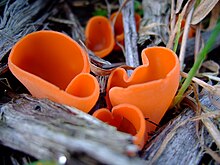
Aleuria aurantia (orange peel fungus) is a widespread ascomycete fungus in the order Pezizales. The brilliant orange, cup-shaped ascocarps often resemble orange peels strewn on the ground, giving this species its common name.


Taxonomy
Christiaan Hendrik Persoon described the orange peel as Peziza aurantia in 1800. The specific epithet is the Latin word aurantia "orange". Karl Wilhelm Gottlieb Leopold Fuckel placed it the genus Aleuria in 1870.
Description
In Europe, the orange peel may be confused with species of Otidea or Caloscypha which are poisonous or of unknown edibility. The North American Audubon Mushroom Field Guide and others list orange peel fungi as edible,[1] though not necessarily choice, with no particularly notable continental lookalikes.
Distribution and habitat
The orange peel fungus grows on bare clay or disturbed soil throughout North America and Europe. It has also been found in the south of Chile. Aleuria aurantia fruits mainly in late summer and autumn.
| This article uses material from the Wikipedia article Metasyntactic variable, which is released under the Creative Commons Attribution-ShareAlike 3.0 Unported License. |