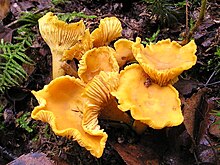
Cantharellus cibarius (Latin: cantharellus, "chanterelle"; cibarius, "culinary")[2] is a species of golden chanterelle mushroom in the genus Cantharellus. It is also known as girolle (or girole).[3][4] It grows in Europe from Scandinavia to the Mediterranean Basin, mainly in deciduous and coniferous forests.[3][5][6][7] Due to its characteristic color and shape, it is easy to distinguish from mushrooms with potential toxicity that discourage human consumption. A commonly eaten and favored mushroom, the chanterelle is typically harvested from late summer to late fall in its European distribution.[3]


Chanterelles are used in many culinary dishes,[3][5] and can be preserved by either drying or freezing. An oven should not be used when drying it because can result in the mushroom becoming bitter.[3]
Taxonomy
At one time, all yellow or golden chanterelles in North America had been classified as Cantharellus cibarius. Using DNA analysis, they have since been shown to be a group of related species known as the Cantharellus cibarius group or species complex, with C. cibarius sensu stricto restricted to Europe.[6][7][8] In 1997, the Pacific golden chanterelle (C. formosus) and C. cibarius var. roseocanus were identified,[9] followed by C. cascadensis in 2003[10] and C. californicus in 2008.[11]
Description
The mushroom is easy to detect and recognize in nature.[3] The body is 3–10 centimetres (1–4 inches) wide and 5–10 cm (2–4 in) tall. The color varies from yellow to dark yellow.[3][5] Red spots will appear on the cap of the mushroom if it is damaged.[12] Chanterelle mushrooms have a faint aroma and flavour of apricots.[3][5]
Care should be taken not to confuse this species with the deadly Omphalotus illudens.[13]
| This article uses material from the Wikipedia article Metasyntactic variable, which is released under the Creative Commons Attribution-ShareAlike 3.0 Unported License. |