Clitocybe nebularis or Lepista nebularis, commonly known as the clouded agaric or cloud funnel, is an abundant gilled fungus which appears both in conifer-dominated forests and broad-leaved woodland in Europe and North America. Appearing in Britain from late summer to late autumn, it is edible, but may cause gastrointestinal issues. It is classified as a category-4 edible mushroom in Russia.[2]


Taxonomy
The species was first described and named as Agaricus nebularis in 1789 by August Johann Georg Karl Batsch. It was later placed in the genus Clitocybe in 1871 by Paul Kummer as Clitocybe nebularis. After much consideration by many mycologists, over some years, when it was placed for periods in both Lepista, and Gymnopus, it was placed back in Clitocybe with the specific epithet, and 1871 creditation it retains today.
Clitocybe nebularis var. alba Bataille (1911), differs only in having a milk white cap, and is very rare.[3]
Description
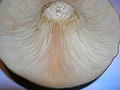
The cap of the mushroom is 5–25 cm (2–8 in) in diameter, convex with an incurved margin, becoming plane to depressed in shape. Cap colours are generally greyish to light brownish-grey, and often covered in a whitish bloom when young. The surface of the cap is usually dry to moist, and radially fibrillose. The stem is stout, swollen towards the base, becomes hollow with age, and is easily broken. It is usually somewhat lighter than the cap.[3] The flesh is white, and very thick. It has a foul-smelling odour, which has been described as slightly farinaceous to rancid.[4]
This species is host to the parasitic gilled mushroom Volvariella surrecta, which is found on older specimens.
It may be confused with the poisonous Entoloma sinuatum both in Europe or North America, though this species has pink sinuate gills.[5]
Edibility
The species is edible but even a small portion can cause gastrointestinal disturbances for some people.[6]
Gallery



| This article uses material from the Wikipedia article Metasyntactic variable, which is released under the Creative Commons Attribution-ShareAlike 3.0 Unported License. |