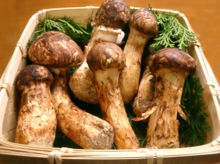
Matsutake (Japanese: 松茸), Tricholoma matsutake, is a highly sought species of choice edible mycorrhizal mushroom that grows in Asia, Europe, and North America. It is prized in Japanese, Korean, and Chinese cuisines for its distinct spicy-aromatic odor.[3][4]


Habitat and distribution
Matsutake mushrooms grow under trees and are usually concealed under litter on the forest floor, forming a symbiotic relationship with roots of various tree species.
Matsutake mushrooms grow in eastern Asia in China, Japan, Korea, Bhutan and Laos; in Europe, in Estonia, Finland, Norway, Poland and Sweden; and on the Pacific coasts of Canada and the United States.
In Korea and Japan, matsutake mushrooms are most commonly associated with Pinus densiflora.[5]
Similar species
In the North American Pacific Northwest, Tricholoma murrillianum is found in coniferous forests of one or more of the following tree species: Douglas fir, Noble fir, Shasta red fir, Sugar pine, Ponderosa pine, or Lodgepole pine. In California and parts of Oregon, it is also associated with hardwoods, including Tanoak, Madrone, Rhododendron, Salal, and Manzanita.[citation needed] In northeastern North America, the closely related mushroom Tricholoma magnivelare is generally found in Jack pine forests.[6] A report published in 2000 indicated that Tricholoma nauseosum and matsutake (T. matsutake) are the same species.[7]
Cost and availability
Though simple to harvest, matsutake are hard to find because of their specific growth requirements and the rarity of appropriate forest and terrain, combined with competition from wild animals such as squirrel, rabbits and deer for the once-yearly harvest of mushrooms, causing the price to be very high at times or as low as $4.41 per kilogram ($2 per pound) for pickers when the market will bear it. Domestic production of matsutake in Japan has been sharply reduced over the last 50 years due to the pine-killing nematode Bursaphelenchus xylophilus, which has influenced the price a great deal. The annual harvest of matsutake in Japan is now less than 1,000 tons, and the Japanese mushroom supply is largely made up by imports from China, Korea, America's Pacific Northwest, and British Columbia), and northern Europe.[8] The price for matsutake in the Japanese market is highly dependent on quality, availability, and origin. The Japanese matsutake at the beginning of the season, which is the highest grade, can go up to $1,000 per kilogram. In contrast, the average value for imported matsutake is about $90 per kilogram.[9]


| This article uses material from the Wikipedia article Metasyntactic variable, which is released under the Creative Commons Attribution-ShareAlike 3.0 Unported License. |