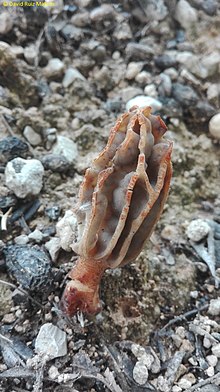
Morchella anatolica is a species of ascomycete fungus in the family Morchellaceae that was described as new to science in 2010. It is found in Southwest Anatolia, Turkey, where it grows on moss-covered stream beds in pine forests. The fruit bodies grow to 30–35 mm (1.2–1.4 in) tall and 8–10 mm (0.31–0.39 in) wide. They are roughly conical, with fleshy longitudinal ribs that lack the cross-ribs characteristic of most other Morchella species. Young specimens have a light lilac tint that darkens or turns grayish in maturity.[1]

The ascospores of this fungus are ellipsoid to broadly ellipsoid, hyaline (translucent), and measure 24–30 by 18–18 μm; these dimensions are relatively large for the genus Morchella. Fine longitudinal grooves are present on the surface of mature spores. The spores are produced in groups of eight in cylindrical to club-shaped asci measuring 290–310 by 18–26 μm.[1]
Morchella anatolica has also been found in Spain, and is closely related to M. rufobrunnea.[2]
| This article uses material from the Wikipedia article Metasyntactic variable, which is released under the Creative Commons Attribution-ShareAlike 3.0 Unported License. |