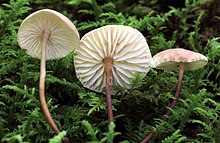
Mycetinis scorodonius (syn. Marasmius scorodonius) is one of the garlic-scented mushrooms formerly in the genus Marasmius, having a beige cap of up to 3 cm and a tough slender stipe.[2][1][3]


Description
The species can be described as follows:[3][2][4][5]
- The cap is red brown (or sometimes beige to ochre) and is hygrophanous, drying to a paler colour. It is sometimes slightly wrinkled and grows to 1–3 cm in diameter.
- The gills are white and fairly crowded, and the attachment to the stem varies from adnate to almost free. The spore powder is white.
- The stem can grow to 6 cm tall but is only up to 2 mm in diameter. It is bald and pale at the apex, reddish brown lower down, and dark brown or blackish at the base.
- The smell and taste are strongly of garlic.
- The spores are roughly ellipsoid and measure 7–11 µm x 3–5 µm.
- The cheilocystidia (on the gill edge) are of the "broom cell" type, that is, they are club-shaped with a number of finger-like protuberances.
The species epithet is a Latin adjectival form of the Greek word for garlic, scorodon (σκόροδον).[6]
This species was originally documented as Agaricus scorodonius by Fries in 1815 and in 1836 the same author established its long-standing designation Marasmius scorodonius. However following a 2005 paper it was decided to separate a group of garlic-smelling species, including this one, off into genus Mycetinis (see that page for more details).[3][1]
Mycetinis virgultorum is (according to Species Fungorum) a closely related species,[7] or (according to Antonín and Noordeloos) a variety within the same species. In the latter classification, the two forms are called M. scorodonius var. scorodonius and M. scorodonius var. virgultorum. The virgultorum form has smaller fruiting bodies, a scaly dull stem, and smaller spores.[3]
Ecology, distribution and edibility

This mushroom is found from summer to late autumn especially on conifer needles, but also on sticks and other debris, on bark of conifers and deciduous trees, and on grasses and other plants. While usually a saprophyte, it has also been reported as a parasite of grass.[3][4]
It is fairly common in northern and central Europe, present in the remainder of Europe, and reported from eastern North America,[8] North Africa and Asia, including Israel.[3][2]
The taste of M. scorodonius is often described as nasty or unpleasant.[3][9] Although edible, it is too small to be substantial.[10] They can be used to add a garlic flavour to dishes.[5][11]
| This article uses material from the Wikipedia article Metasyntactic variable, which is released under the Creative Commons Attribution-ShareAlike 3.0 Unported License. |