Porphyrellus porphyrosporus, commonly known as the dusky bolete, is a rare fungus belonging to the family Boletaceae. With its purple-brown cap and stem, Porphyrellus porphyrosporus is not easy to spot, despite its large size. This summer and autumn species occurs under pines, but can also be found beneath deciduous trees. It is a large (both cap diameter and stem length up to 15 cm) brown bolete. Its most distinctive features are the purple-brown spore print and the blue-green colour of the flesh at the top of the stem and above the hymenium. This is a widespread species of Europe, especially in the north, but is nowhere particularly common. The fruit bodies appear from late summer to autumn, often in small groups, associated with broad-leaved trees such as beech and oak.
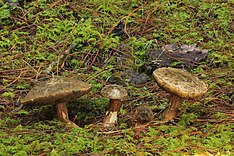


Description
This mushroom has a dark brown cap with a noticeably paler margin. Initially convex, caps expand and sometimes become irregularly lobed. It is 6 to 15 cm (2.4 to 5.9 in) in diameter when fully expanded, the caps have soft buff flesh with a vinaceous tinge. When cut or bruised, the tubes turn blue-green. The stem is 1 to 3 cm (0.4 to 1.2 in) in diameter and 5 to 15 cm (2.0 to 5.9 in) tall, the stems of this species are tobacco brown and slightly velvety to the touch when young, becoming smooth as the fruit body matures. The mushroom has an unpleasant sour taste and odour. One guide lists the species as edible,[2] while another considers it "probably edible".[3]

| This article uses material from the Wikipedia article Metasyntactic variable, which is released under the Creative Commons Attribution-ShareAlike 3.0 Unported License. |