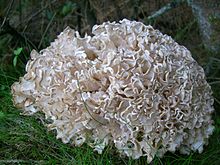
Sparassis (also known as cauliflower mushroom) is a genus of parasitic and saprobic mushrooms characterised by their unique shape and appearance. This appearance can be described as similar to a sea sponge, a brain, or a head of cauliflower, from which it has been given its popular name.

They are increasingly cultivated and being sold in Korea, Japan, United States and Australia.
The generic name comes from the Greek sparassein meaning to tear.[1]
Species
There are seven species in the genus:[2]
- Sparassis crispa (Wulfen) Fr.
- Sparassis brevipes Krombh.
- Sparassis cystidiosa Desjardin & Zheng Wang[3]
- Sparassis latifolia Y.C. Dai & Zheng Wang[4]
- Sparassis miniensis Blanco-Dios & Z. Wang[5]
- Sparassis radicata Weir
- Sparassis spathulata (Schwein.) Fr.
The best-known and most widely collected species of Sparassis are S. crispa (found in Europe and eastern North America) and S. radicata (found in western North America). These species have a very similar appearance and some authorities treat them as conspecific. Their color can range from light brown-yellow to yellow-grey or a creamy white cauliflower colour. They are normally 10 to 25 cm tall, but can grow to be quite large, with reported cases of fruiting bodies more than half a meter tall and 14 kg in weight. Because of their unique look and size, they are unlikely to be mistaken for any poisonous/inedible mushrooms. They grow as parasites or saprobes on the roots or bases of various species of hardwoods, especially oak, and conifers, and hence are most commonly found growing close to fir, pine, oak or spruce trees.
Edibility
Sparassis crispa can be very tasty, but should be thoroughly cleaned before use, as the folds can contain dirt and other material, as it grows and envelops objects around it such as pine needles. Antonio Carluccio reports that European Sparassis crispa should be picked when creamy white, and once yellow are too indigestible to eat. It is good for drying and reconstituting, as it retains its cartilaginous texture and hence is good for soups.[6]
S. spathulata, a cauliflower mushroom which looks similar to Grifola frondosa, is edible.[7]
Cauliflower mushroom is more than just a tasty mushroom, it is also widely used as traditional Chinese medicine because it contains materials with pharmacological activity. In order to better study its medicinal value, the genomic sequence of Sparassis crispa was published October 2018.[8] Sparassis crispa was found to have a very high content of Beta-glucan, up to 43.6% [9] of the basidiocarps dry weight. The beta-glucan was approved for of cancer treatment [10] in Japan and most recently recommended for COVID-19 patients [11] to overcome inflammation.
Experiments suggest that S. crispa contains chemicals which may stimulate the immune system and have many biological properties including: Anti-tumor [12] [13], [14] Antiviral Activity (reverse transcriptase inhibitory activity) [15]neuroprotection [16]cardioprotection [17]anti-inflammation [18]hyperlipidemia [19]Anti-diabetic medication [20]Antimicrobial Compounds [21], [22] [23]methicillin resistant Staphylococcus aureus (MRSA) [24]
| This article uses material from the Wikipedia article Metasyntactic variable, which is released under the Creative Commons Attribution-ShareAlike 3.0 Unported License. |